
6. Controlling Delivery in S/4HANA — Why Documentation from Day One Matters

Introduction
This article is the sixth and final in a series exploring the real-world challenges organisations face when migrating to S/4HANA — based on what I have seen happen on programmes.
This time, we look at documentation — and why it is often treated as an administrative task, rather than what enables control, continuity, and scale.
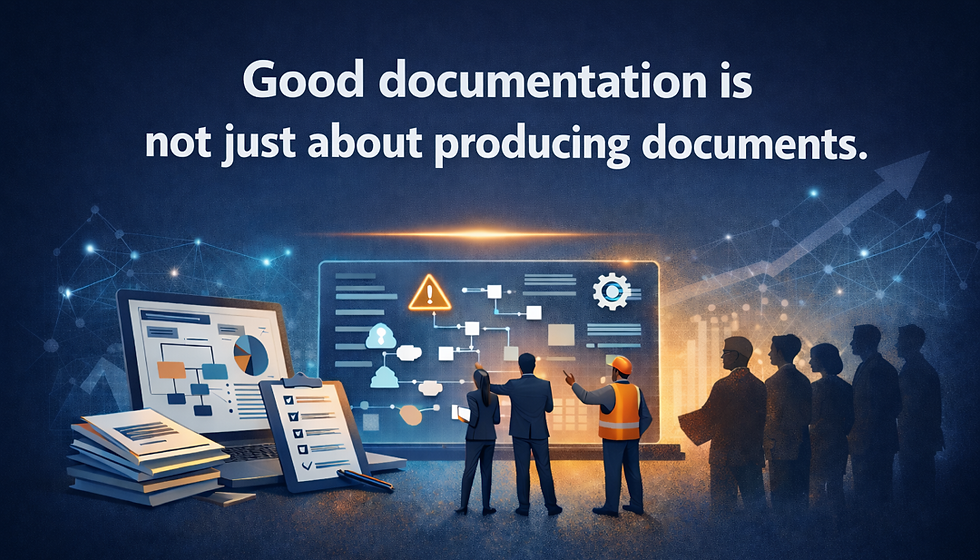
Good documentation is not just about producing documents.
S/4HANA programmes don’t lose control suddenly — they lose it gradually, as decisions, assumptions, and actions stop being clearly captured.
In many S/4HANA programmes, documentation is treated as something that should “catch up later” — or as a deliverable in its own right.
Good documentation is about capturing risks, actions, assumptions, issues, decisions, and outcomes in a way that allows the programme to operate effectively.
Design documents are also important — but they should follow demonstrations of the process in a working sandbox environment, not precede them.
When users can see how the process works in practice, sign-off becomes more straightforward, and the need for rework during Realise is significantly reduced.
The Reality: Loss of Control
Without structured documentation from the outset, programmes begin to lose control:
Decisions are revisited because they were never clearly recorded — including goals, assumptions, or participants.
Different teams work from different assumptions
New joiners struggle to understand the current state
Dependencies are missed or misunderstood
Risks and issues are tracked inconsistently
What starts as a small gap quickly becomes a systemic problem.
Because S/4HANA programmes are not just complex — they are interdependent.
Documentation as a Delivery Control Layer
Documentation is not a static record — it is the mechanism that allows the programme to function.
It provides visibility of:
What has been decided
What is in progress
What remains open
Where dependencies exist
How design is evolving
Without this, alignment becomes temporary — and control becomes fragile.
In well-run programmes, documentation is not separate from delivery — it is what drives it.
When used effectively, a structured toolset (e.g. Jira / Confluence) enables:
Automatic reporting on progress of actions
Clear status for project and governance meetings
Visibility of cross-functional dependencies
Prioritisation of work across teams
Real-time understanding of design maturity
It also provides structure to design itself:
What fits standard
What requires gaps
Classification of gaps (e.g. interfaces, workflows)
MOSCOW prioritisation
T-shirt sizing for effort
Early definition of Epics and User Stories for Realise
This is not documentation as an output.
This is documentation as a control system for delivery.
RAID Is Not Enough — It Needs to Be Alive
Most programmes will have a RAID log.
But in practice, RAID is often:
Static rather than actively managed
Maintained by a single individual rather than owned collectively
Disconnected from design decisions and delivery progress
Effective RAID management requires:
Clear ownership
Regular review and update
Direct linkage to actions, decisions, and outcomes
It should reflect the current reality of the programme — not a snapshot from last week.
Design Without Documentation Does Not Stay Aligned
In workshops, decisions are made quickly — often supported by demonstrations rather than detailed design documents.
This is the right approach.
But for it to work, those decisions must be captured clearly and made immediately visible to all stakeholders
Not as lengthy documents — but as structured, traceable records that:
Can be shared and reviewed
Drive follow-on actions
Feed directly into delivery
Without this, demo-led delivery breaks down — because the outcome of the demo is not consistently understood or applied.
Tools Matter — But How They Are Used Matters More
Tools such as Jira and Confluence are not just repositories — they are operational platforms for the programme.
Their value comes from:
Capturing decisions at the point they are made
Structuring work into actions, Epics, and User Stories
Providing real-time visibility across teams
Enabling reporting without manual effort
When used properly, they replace fragmented tracking across emails, spreadsheets, SharePoint sites and disconnected logs.
When used poorly, they become just another place where information is lost.
Leading systems integrators often bring preconfigured toolsets and templates that can accelerate this setup from the outset — providing structure for capturing design decisions, tracking gaps, and managing delivery.
However, these only add value when they are actively used and embedded into the way the programme operates.
Without that, even the best tools and templates quickly become unused repositories rather than drivers of delivery.
From Day One — Not After Mobilisation
A common assumption is that documentation can be completed later:
In reality, if it is not captured in a timely manner:
Context is already lost
Decisions are harder to reconstruct
Inconsistencies become embedded
The effort required to regain alignment increases significantly
“From day one” means exactly that — from the outset of the programme.
Not halfway through Explore, but from the point resources land. The tools should be in place, and teams should be trained and expected to use them consistently.
More importantly, it ensures that everyone has visibility of what is happening across the programme — without which alignment cannot be maintained across teams.
Starting from day one ensures that:
Decisions are captured as they are made
Alignment is maintained across teams
Dependencies are visible and understood
Knowledge is retained as the programme evolves
What Good Looks Like in Practice
Effective programmes treat documentation as part of delivery, not separate from it.
It becomes the mechanism through which the programme is coordinated, not just recorded.
In practice, this looks like:
Meeting outcomes captured and shared within 24 hours
Clear documentation of decisions taken, including context and participants
Actions tracked with ownership, priority, and linkage to dependencies
Visibility maintained across stakeholders, ensuring teams stay aligned
Gaps clearly defined, classified (e.g. interfaces, workflows), and prioritised (e.g. MOSCOW)
Design status visible across the programme (what fits vs where gaps remain)
Cross-functional dependencies explicitly identified and tracked
Work structured early into Epics and User Stories to support transition into Realise
Reporting and status updates generated directly from the toolset, not manually compiled
This may sound ambitious — but with the right tooling and discipline, it is entirely achievable, and I have seen it work effectively on well-run programmes.
The goal is not to document everything — but to document what enables the programme to stay aligned and under control.
Supporting Delivery — Not Slowing It Down
There is often a concern that documentation creates overhead.
In reality:
Poor documentation slows delivery
Good documentation enables it
It reduces:
Rework
Misalignment
Dependency risks
Time spent rediscovering decisions
And it increases:
Clarity
Accountability
Confidence in delivery
I have seen a significant difference in the number of changes required later, and in how often decisions are revisited, between programmes where documentation is managed properly and those relying on spreadsheets that are overwritten or not maintained with an auditable history.
Final Thought
S/4HANA programmes are complex, fast-moving, and involve multiple teams and stakeholders.
Without structured documentation, control is gradually lost — often without being immediately visible.
Documentation is not an administrative task.
It is what enables:
Continuity
Alignment
And control of delivery across the programme
Start from day one. Keep it relevant. Keep it live.
Because if it isn’t captured as the programme progresses:
👉 Teams move forward — but not in the same direction.
S/4HANA Transformation Series
When “Agile” S/4HANA Programmes Quietly Revert to Waterfall — and Why It Matters
Fit-to-Standard — But Which Standard Are You Actually Choosing?
Why Data Will Make or Break Your S/4HANA Programme — Long Before Go-Live
Right-Sizing Change Management in S/4HANA — Why Timing Matters More Than Headcount
Rationalising External Systems in S/4HANA — Why Integration Simplicity is a Strategic Advantage
Documentation from Day One — Why Documentation from Day One Matters


Comments